
Hanover Probation and Parole Compared
Both terms describe supervision, but they begin in different ways. Probation is ordered by a court. It may replace jail time, follow a jail or prison term, or apply to a local sentence. Parole is conditional release for a person whom the Virginia Parole Board finds eligible and grants release under the statutes that govern that case. Virginia largely ended discretionary parole for felonies committed on or after January 1, 1995, yet older sentences and statutory exceptions remain. The actual VADOC and Board records control.
Hanover also has a local layer. A person released on bond may report to Pretrial Services. Someone with a qualifying local sentence may report to Hanover Community Corrections. Neither status should be mislabeled as state parole. The following comparison keeps the records and offices distinct.
| Question | Probation | Parole |
|---|---|---|
| Who authorizes it? | The sentencing court | Virginia Parole Board under applicable law |
| When can it begin? | Without prison, after custody, or with a suspended term | After conditional release from state custody |
| Where is state supervision checked? | VADOC Locator and the assigned district | VADOC Locator, District 41, and Board reports when applicable |
| Does it prove full discharge? | No. The term may still be active. | No. Release is conditional until discharge. |
- Probation
- Court-ordered community supervision, sometimes after a custodial term.
- Parole
- Conditional community release for a legally eligible state prisoner.
- Discharge
- The formal end of the applicable custody or supervision term.
- Absconder
- A person alleged to have stopped reporting or whose location is unknown while supervision remains active.
Check Hanover Post-Release Supervision
Start with identity and custody class. The VADOC Inmate and Supervisee Locator covers state institutions and people supervised through district offices. It asks for a seven-digit DOC ID, or the first three letters of the first name and the full last name. Optional filters include location, race, gender, and age range. VADOC says the data is updated daily and may contain errors or lag.
A district-office result supports current community-supervision status. An institution result means the person is still displayed in custody. No result does not prove discharge. A spelling issue, an old inactive file, a local-only case, or a change outside the public scope may explain it.
- Search by DOC ID when it is known, then compare the name and other lawful identity details.
- Read the location and status labels exactly. Do not turn a district result into a claim that the entire sentence ended.
- If District 41 appears, confirm the current office through the VADOC directory and call only for information staff may lawfully provide.
- Check the Hanover sentencing court when the probation term, suspended sentence, or discharge order is the key fact.
- For an inactive or historical state record, request releasable records from VADOC instead of treating a blank search as proof.
Important: A release from a prison and a discharge from supervision are separate events.
Hanover Parole District 41
VADOC Probation and Parole District 41 is the state community-supervision office serving Hanover County, Caroline County, and the Town of Ashland. That shared territory matters. A record tied to Hanover may display a district whose reach extends beyond the county, and a case associated with Caroline can still route to the Ashland office.
VADOC Probation and Parole District 41103 Green Chimneys Court, Suite A
Ashland, VA 23005
804-368-3846
The live VADOC facilities and offices directory is the proper source for the current phone and office assignment. Older agency material listed another phone, so the current directory number should lead. Staff can help identify the right reporting office, but privacy and safety rules may limit treatment, residence, victim, or risk information.
A District 41 result means the person appears in VADOC’s community-supervision data. It does not show that all court duties have ended. For a fuller release and records path, use the Hanover County released-inmate search alongside the court and agency record.
Note: Office assignment is useful evidence of supervision, but only a discharge record establishes that the supervision term ended.
Hanover Local Supervision After Release
Hanover Community Corrections and Pretrial Services is not District 41. It operates at a different Ashland address and serves a local court-related role. Pretrial Services interviews eligible people before an initial bail hearing and supplies information to the judicial officer. When a judge orders pretrial supervision as a bond condition, the person must report as directed after release. That does not mean the charge was dismissed or that probation has begun.
Local community-based probation can supervise qualifying local sentences. Hanover states that local supervision may carry a fee of no more than $150, while pretrial supervision has no supervision fee, though a court-ordered service can have its own cost. Those details belong to the local program, not VADOC parole.
Hanover Community Corrections and Pretrial Services9714 Atlee Commons Drive
Ashland, VA 23005
804-365-6873
The official Hanover Community Corrections page explains the local program. A bond order, local sentencing order, or program record identifies this path. The VADOC locator may not be the right tool for a person whose supervision exists only under the county program.
Hanover Parole Board Records
The Virginia Parole Board decides eligible state parole cases. It does not run Hanover’s local probation program, and it is not the day-to-day District 41 office. Since July 1, 2024, the Board says final deliberation and votes on parole grants occur in public meetings. Its public-meetings page posts scheduled meeting details, links when available, and prior minutes. Meetings occur as cases require, not on a fixed Hanover calendar.
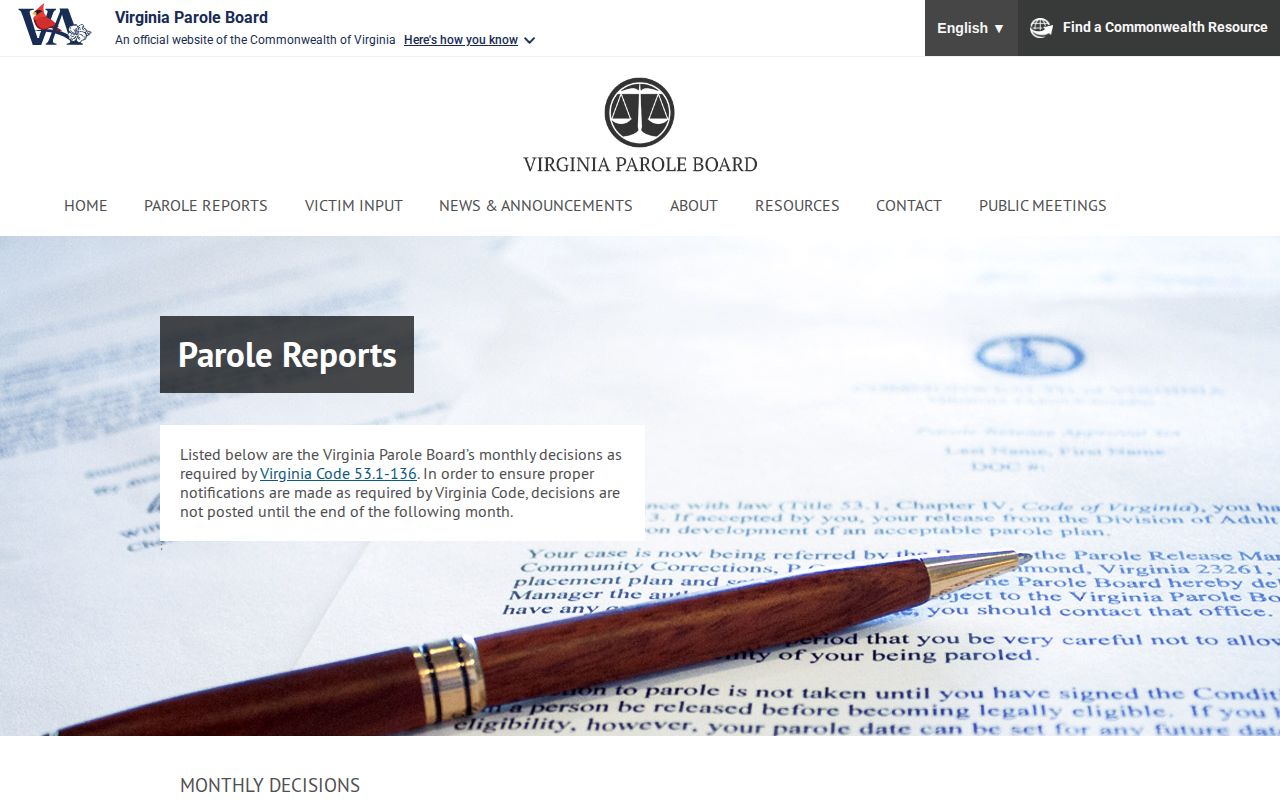
Results are organized by month and year on the Board’s parole reports page. Reports may contain a DOC number, case type, decision date, jurisdiction, sentence information, reasons, and member votes. Use the exact decision terms in the report. A grant is legal authorization in the parole process, not proof of the later physical exit time.
The Board says it does not provide public status updates about pending parole or pardon cases. Public reports are therefore the result channel, while VADOC release paperwork and a community-supervision result help confirm what happened after a grant.
The monthly reports source shows how Board outcomes are published:
Hanover Parole Eligibility Records
Eligibility and release are not the same. Virginia Code § 53.1-151 sets the main legacy eligibility framework and contains special rules and exclusions. For an ordinary eligible first commitment, the statute describes eligibility after one-fourth of the term or twelve years if one-fourth is longer. Later commitments use different fractions and caps. Other statutes and exceptions can alter the result.
Most post-1994 felony sentences are not in the old discretionary-parole system, but the law includes exceptions. Offense date alone is not a safe answer. The person’s DOC record, sentence, eligibility category, and Board record must be read together. Even when eligible, the Board must act and VADOC must complete release processing.
Public decision reports can explain a grant or denial. They should not be mined for facts unrelated to verification. When exact release matters, the signed Order of Release or notification-of-release letter is stronger than a meeting date or eligibility estimate.
Hanover Supervision Violations and Absconders
Supervision conditions depend on the signed order and case. Common duties can include reporting, obeying court or Board terms, and completing directed programs. A claimed violation can lead to review, a warrant, a court hearing, or Board action. It does not by itself prove revocation. Read the agency or court result before describing the outcome.
VADOC’s Most Wanted page is not a full list of violations. An absconder remains subject to supervision and enforcement even when the person’s location is unknown. Likewise, a Hanover Sheriff wanted notice does not establish parole status. For an urgent safety concern, use the named agency’s official contact route. For a record question, match the warrant, violation report, or court event to the correct person and case.
Note: A wanted notice can support an enforcement status, but it does not replace the supervision record or court disposition.
When Hanover Supervision Ends
Supervision ends through a formal discharge, expiration, court action, or other authorized agency process. A person can leave prison yet remain on parole or probation. The reverse distinction also matters: local pretrial supervision may end with a court action without ever becoming probation. The record must name the status.
For state cases, ask VADOC for a verified discharge or releasable inactive-record response when the public locator no longer answers the question. For court probation, obtain the relevant Hanover order or docket entry. The General District Court can hold local misdemeanor and preliminary matters, while Circuit Court handles felony adjudication and appeals. Check the court that owns the sentence.
Keep dates source-specific. A prison release date, start of District 41 supervision, Board decision, and final discharge date can all differ. Recording each event with its agency prevents a conditional release from being mistaken for the end of every legal obligation.