
Trace Hanover Release Date Events
Several correct dates can describe one person’s path. A court may award credit from an earlier jail stay. PRJ may later record a turnover to VADOC. VADOC may publish a future date, move the person between institutions, and finally execute release to District 41 supervision. Those entries describe different steps. None should be substituted for another.
Build the sequence from official records. Begin with the sentencing order and any credit order. Add the PRJ commitment, turnover, or release entry. Then read the VADOC result and request executed release papers when the event has occurred. If a detainer sends the person to another agency, add that receiving agency’s result before describing community status.
This sequence resolves apparent conflicts. A jail record can truthfully say the person left PRJ while VADOC still shows an institution. A VADOC projected date can pass while a detainer keeps the person in other custody. A District 41 entry can show physical prison release even though supervision remains active. Label the agency beside each date.
When sources disagree, keep each observation time and contact the record custodians. Do not average dates, apply a sentence percentage, or choose the one that seems most plausible. An executed movement or release record is stronger evidence than an estimate.
Hanover Projected and Actual Release
A projected date is prospective. It reflects the sentence data, credit rules, custody record, and known legal holds available when the authority computes it. An actual release is an event that has occurred. For VADOC, a signed Order of Release, notification-of-release letter, or executed agency record is stronger proof than a future date on a search result.
Pretrial custody works differently. Someone held at Pamunkey Regional Jail while charges are pending may leave after bond is posted, recognizance is ordered, a case changes, or a detainer is resolved. No sound percentage formula can predict those events. A court order may authorize release, but PRJ still must process the departure and check all other holds.
Scheduled versus actual: Never report a future date as a promise. Recheck the custody result and obtain the executed release entry when the exact event matters.
- Projected date
- A date computed from the current sentence and credit data that may change.
- Actual release
- The recorded departure from that agency’s custody.
- Detainer
- A hold or request from another authority that can redirect a person into other custody.
- Concurrent sentences
- Terms that run at the same time, unlike consecutive terms that run one after another.
Search Hanover Projected Release Records
The correct channel follows the sentence. For a VADOC prisoner, use the official Inmate and Supervisee Locator. Search by seven-digit DOC ID when possible. Name searching uses the first three letters of the first name and the full last name, with optional location, race, gender, and age-range filters. VADOC says its public data updates daily and may be inaccurate or outdated.
Use the exact date label displayed on the result. Research confirmed that the entry page describes release-date access, but a result screenshot did not capture a person-specific date label. A future release date on a current institutional result is best treated as projected or anticipated in practical terms, not renamed as an official “Projected Release Date” field unless the interface itself uses that label.
- Decide whether the person is at PRJ, in VADOC custody, under community supervision, or still awaiting a court outcome.
- For VADOC, search by DOC ID or careful name matching and read each status, location, and date label word for word.
- For a local sentence, call PRJ Records and obtain the Hanover court disposition and existing time-computation or release entry.
- Check for another case, warrant, detainer, or receiving agency before treating a date as community release.
- After the date passes, recheck the locator and seek the executed release paperwork instead of assuming departure occurred.
The VADOC search source shows its public fields, scope, and update warning:

Virginia Credits for Hanover Releases
Virginia has more than one sentence-credit regime. Good Conduct Allowance, or GCA, applies mainly to felony offenses committed before January 1, 1995 and misdemeanors committed before July 1, 2008. VADOC states that GCA ranges from zero to 30 days for each 30 days served, depending on the class. Virginia Code §§ 53.1-198 and 53.1-202 govern that framework.
Earned Sentence Credit, or ESC, applies to felonies committed on or after January 1, 1995. ESC-1 offenses earn from zero through 4.5 days for each 30 days served. At the top 4.5-day rate, serving 30 days plus receiving 4.5 credit days satisfies 34.5 days. That equals about 86.96 percent actual service, not exactly 85 percent. Calling Virginia’s rule a flat 85 percent formula is inaccurate.
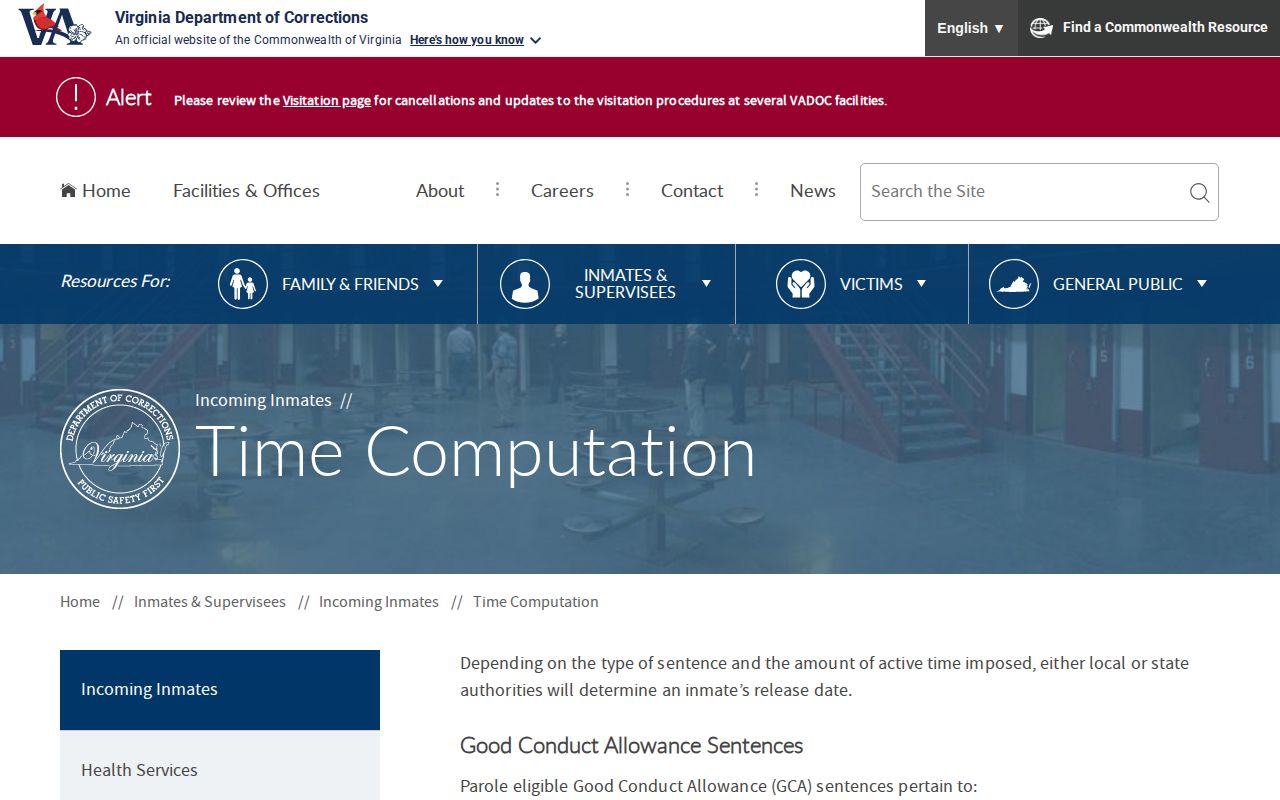
Eligible ESC-2 sentences may earn as much as 15 days per 30 served. Section 53.1-202.3 identifies excluded or limited offenses and ESC-2 eligibility, while §§ 53.1-202.2 and 53.1-202.4 address earning classes and application. The offense, date, sentence structure, and earning class all matter. No page or unofficial calculator should compute a date for an individual.
The official rate source gives the controlling categories and variables:
Note: A statutory maximum credit rate is not a personal calculation and does not establish the date any named person will leave custody.
Why Hanover Release Dates Change
VADOC and local authorities calculate time from official records. Inputs include pretrial jail credit, the active term, consecutive or concurrent structure, disciplinary changes, and court amendments. VADOC performs the computation for qualifying state sentences, including certain state-responsible people housed in local or regional jails. The local or state authority may calculate other sentence types based on active time and custody.
| Factor | Effect on the record |
|---|---|
| Credit from prior confinement | Must be supported by the court or facility record and entered correctly. |
| Earning-class change | Can alter the rate of future earned credit. |
| Disciplinary loss | May reduce credit and move a prospective date later. |
| Corrected or amended court order | Can change active time or sentence structure. |
| Consecutive sentence | Adds a term that does not run at the same time. |
| Warrant or detainer | May block community release or send the person to another authority. |
| Parole action | Eligibility or a grant affects the lawful route, but release processing still must occur. |
A date passing is not enough. OP 050.3 requires final checks for identity, sentence computation, warrants, detainers, court orders, and discipline. A discharge to a criminal detainer ends physical VADOC custody while another agency’s custody begins.
Hanover Weekender Release Computations
Pamunkey Regional Jail has a local computation detail that defeats simple calendar math. Its fiscal-year annual report says Records staff track people serving Friday-through-Sunday “weekender” periods. Staff record each day and the correct release time. The same office computes credit for time served at other facilities and enters court dispositions that determine release eligibility.
Ask PRJ Records for the existing computation and movement entry. Pair it with the court disposition. Do not assume that a weekend sentence works like one continuous stay, that each calendar day earns the same credit, or that a Friday arrival fixes a Sunday exit time. The court and jail records supply the inputs.
PRJ Records can be reached through 804-365-6400, extension 3033. Booking/Release is extension 3043. The official PRJ directory is the source for those routes. Administrative contact hours do not define release-processing hours.
Note: PRJ’s weekender tracking is a records process, not a public calculator or a guaranteed release schedule.
Request Hanover Projected Date Records
VADOC Operating Procedure 050.6 permits written release of projected parole-eligibility, mandatory-parole, or good-time release dates as of the inquiry, along with custody or parole status and facility location. That creates a records fallback when the live locator does not display an older or fully discharged record.
Use the VADOC public-records route and ask for an existing record. For historical files, VADOC provides Form 17 for inactive inmate or CCAP probationer/parolee records. A precise request can seek the projected date as of a named date, the executed Order of Release, notification letter, and verified discharge status. The custodian may redact or withhold protected material.
For PRJ, use the authority’s FOIA page. Include the legal name, booking identifier if known, approximate stay, and the exact computation or release entry sought. PRJ is an independent regional authority, so Hanover County’s courtesy fee rules should not be promised as PRJ policy.
Confirm Hanover Actual Release Dates
After a projected date, check the current agency again. A VADOC institution result supports continued custody. A District 41 result supports community supervision after prison release, subject to the daily-update limit. A signed Order of Release or notification letter gives stronger event proof. If the person was at PRJ, request the movement disposition and see whether it says release, VADOC turnover, or transfer.
A custody alert can help with timing. The resolved Hanover VINELink inmate search explains local jail events, while VADOC’s separate NAAVI notification handles eligible state-prison events. An alert from one provider confirms what that provider reported. It cannot rule out pickup by another authority.
Keep a clear chain: predicted date, later custody result, executed event, and any receiving agency. That method answers when someone left a named system without overstating where the person went next.